
How to Search More Effectively
In this guide, you will find advice on how to work with keywords that relate to your work's topic and how to use operators to narrow down and improve the selection of relevant information sources. In the last tab, you will find links to other online learning materials.
The precise choice of keywords entered into the search engine is crucial for the number of sources found and their relevance.
- General keywords will result in too many results, making it difficult to navigate.
- Very specific technical terms, on the other hand, may lead to no results at all.
Entering keywords in English significantly increases your chances of finding relevant texts. There are significantly more academic articles and books written in English than in Czech.
How to create keywords?
When choosing keywords, ask yourself the following questions:- What words best describe the topic of my work?
- What type of information do I require? General? Specialized? Scientific? The choice of information sources defines the possible search terms.
- What other words can describe my topic? Have I looked for synonyms, broader or narrower terms?

A thesaurus is a dictionary that shows relationships between concepts such as superordination and subordination. It allows you to expand or refine your chosen keywords and thus find more suitable sources.
Thesauri can be created for a wide range of fields (sometimes for an entire language), but specialized ones, focusing on a specific scientific area, can also be found.
Example of thesaurus output:
Online Thesauri
- ProQuest Thesaurus – a multi-topic thesaurus from ProQuest with terms in English (for registered users only).
- Polythematic Structured Heading List PSH – a Czech-English dictionary of headings serving as a tool for thematic organization and searching of documents. It contains more than 13,900 headings from all basic areas of human knowledge.
- Thesaurus WordReference.com – allows you to translate keywords from Czech to English and vice versa and find synonyms for a given term. The dictionary also allows you to find English synonyms directly for English terms.
- Other freely available specialized thesauri
Thesauri in the National Technical Library's collection



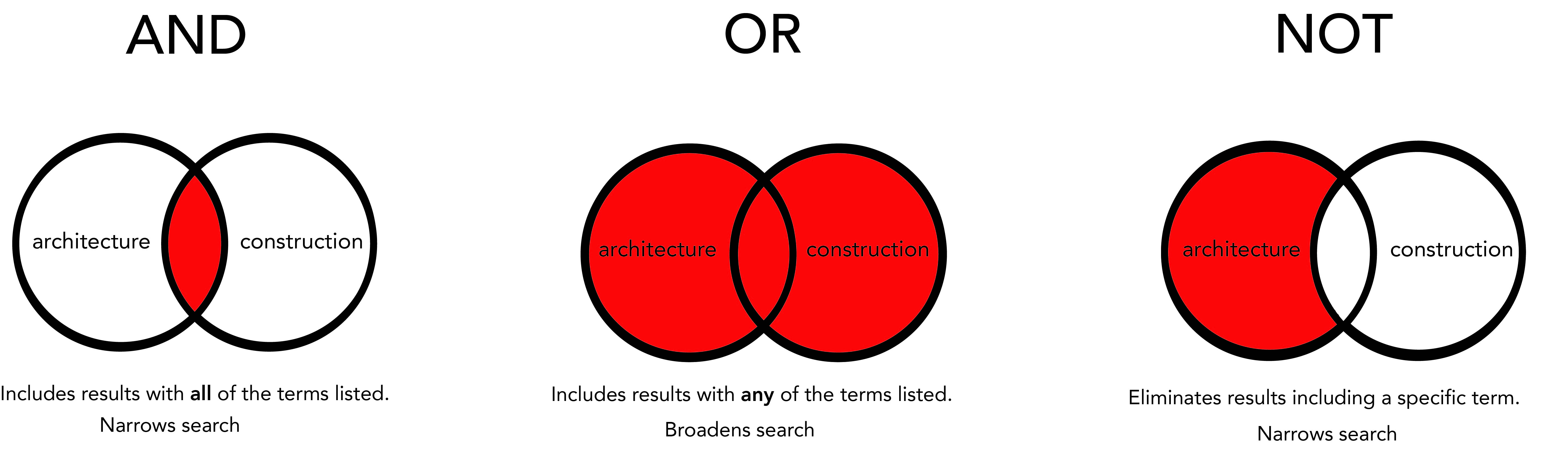
When searching, keywords can be combined with logical operators (sometimes referred to as Boolean operators), which allow you to refine your search query. Depending on the operator used, you can narrow down or expand your search. There are many operators; below, we present the most basic ones.
The form of operators used may vary in different search engines, so it is always necessary to verify their functionality (e.g., Google).
AND Operator
Use AND when searching to:
- reduce the number of results
- get only results that include ALL keywords
OR Operator
Use OR when searching to:
- combine results for 2 or more similar terms (synonyms)
- include results, or get results that contain AT LEAST ONE keyword
NOT Operator
Use NOT when searching to:
- reduce the number of results
- exclude results for a selected keyword that might otherwise be included in your search results
The * Operator
replaces any number of characters in a word. It can therefore be used to find sources containing different forms of a given word.
industr* sul*ur architec*
industry sulfur architect
industrial sulphur architecture
industrialism architectural
industrialization architecturally
The " " Operator
is used for multi-word phrases so that the search engine only shows results for the given phrase and not for individual words, which, if listed separately, may have a completely different meaning.

- NTK Video Tutorials on Searching – instructional videos on how to search for electronic resources or books and how to use NTK library services. You can also use the detailed guide.
- MITLibraries – Database Search Tips: Boolean operators – clear explanation of AND, OR, and NOT operators with examples.
For any questions regarding searching, you can use our consultation services.
Your contact

Vojtěch Turek
- vojtech.turek
- 232 002 548
- 778 453 020